


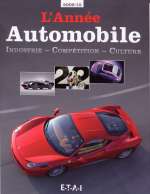
L'ANNEE AUTOMOBILE N 57 2009/10
If there is a publishing work that deserves the title of "bible" for motoring and automobile history enthusiasts, this is undoubtedly L'Année Automobile.
Born in Switzerland as an ambitious publishing project and rapidly transformed into a global institution, this series of yearbooks has represented for over seventy years the most complete, elegant, and authoritative printed testimony of the evolution of four wheels.
L'Année Automobile (also internationally known as Automobile Year) is not a simple magazine, but a true annual encyclopedic compendium. Since its genesis, the aim of the work has been to "freeze" on printed paper the state of the art of the automotive industry, design, and motorsport, year after year, offering posterity an exact and richly illustrated photograph of the car world.
1. Genesis and Publishing History
- The Foundation (1953): The work was established in Lausanne, Switzerland, as the brainchild of Ami Guichard and his publishing house, Edita S.A. The legendary debut volume was released in late 1953, chronicling the 1953/1954 racing season. The vision was to craft an exquisite gift book, distinguished by its meticulous layout and insightful contributions from the most renowned automotive journalists of the era.
- The Evolution: For decades, the yearbook stood as a hallmark of Swiss publishing excellence, led for a significant period by the venerable publisher Jean-Rodolphe Piccard. In 2005, the direction passed to the well-known automotive industry consultant Christian Philippsen. Finally, in 2009, the rights were acquired by the prestigious French publishing house E-T-A-I (Éditions Techniques pour l'Automobile et l'Industrie, now part of the Sophia Éditions group), which still ensures its uninterrupted publication (we are currently at edition no. 73, relating to 2025/2026).
2. The Editorial Concept: The Three Pillars
- Industry and Design (Production): A complete examination of the novelties presented at international motor shows, engineering trends, and the evolution of aerodynamics and design. Historically, this section has always paid special attention to the art of coachbuilding, celebrating Italian masters (Pininfarina, Bertone, Zagato) and the "concept cars" that have defined the future of the vehicle.
- Sport (Motorsport): The beating heart for many readers. The yearbook provides a meticulous account, race by race, of Formula 1, the World Endurance Championship (with in-depth dossiers on the 24 Hours of Le Mans), the World Rally Championship (WRC), and closed-wheel competitions (Touring and GT). All this is enriched by spectacular photographs, technical cutaways of racing cars, and tables containing complete sporting results at the end of the season.
- Culture (Automobile and Society): Articles, essays, and retrospectives signed by automotive historians. This section explores the history of major brands, biographies of illustrious industry figures, the sociological impact of the car, and the world of collecting and auctions.
3. International Editions and the Current Structure
- The Polyglot Era: In the period of its maximum splendor and maximum expansion, the yearbook had a strong international vocation. In addition to the original French version, it was published in full in English (Automobile Year, highly beloved in Anglo-Saxon countries) and, for more limited periods, in other languages, including Italian (often marketed as Anno Automobile, sometimes with the support of local publishers such as Style Auto).
- The Return to the Origins (From 2015): Adapting to the transformations of the global publishing market, starting from Volume 63 (year 2015), the publisher made the decision to stop translations. From that moment, and up to today, publication continues proudly and punctually, but is printed exclusively in French.
4. The Collectible Value
The very first issues are true rarities. In particular, it is said that a large part of the original print run of the very first Volume 1 (1953) was destroyed due to a fire in the printing plant in Switzerland; today, a copy of the first edition in good condition represents the "Holy Grail" for collectors of the series.
Aligning the entire collection of L'Année Automobile on the shelves of a bookcase means possessing a time machine. From the sinuous and pioneering lines of the 50s, passing through the brutal power of Group B in Rallies or the turbo single-seaters of the 80s, up to the contemporary electric revolution, this publication has never betrayed its mission: to elevate the automobile from a mere transport tool to the maximum expression of technology, customs, and human passion.
Product specification
Additional information
Write a Review
Login or Register to write your review